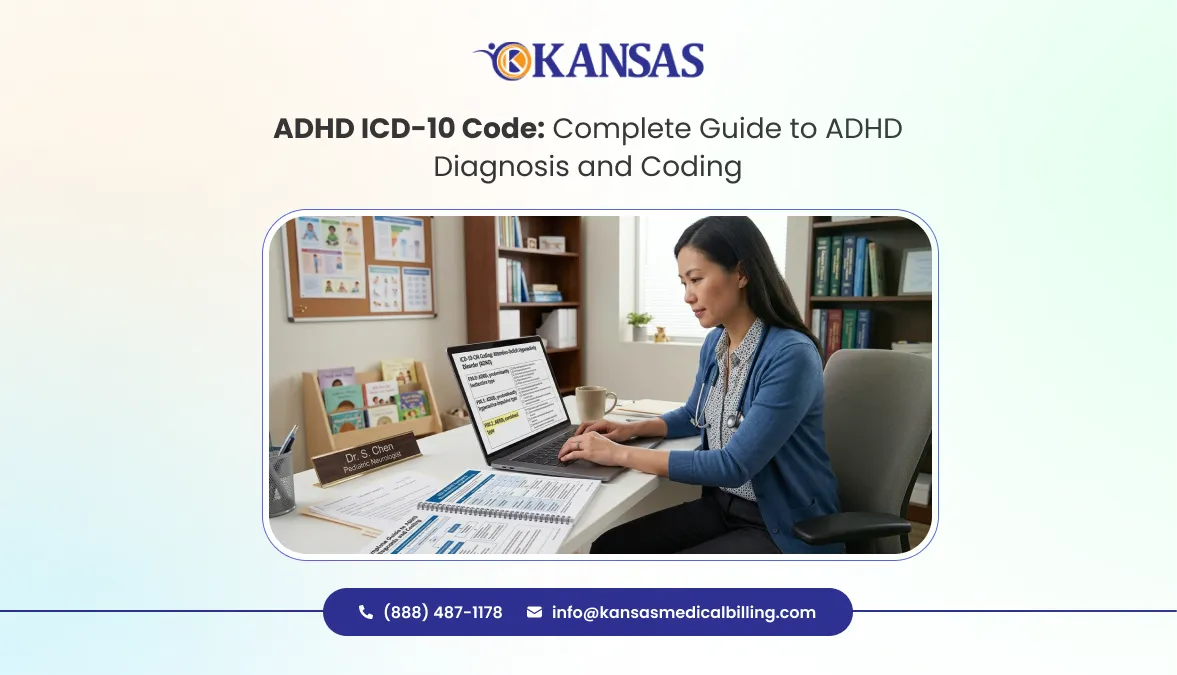
Attention-deficit/hyperactivity disorder (ADHD) is one of the most frequently documented neurodevelopmental conditions in behavioral health, pediatric, and primary care settings. However, selecting the correct ADHD ICD-10 Code is not always as simple as finding “ADHD” in the code book. In real-world medical billing, coding teams often face challenges when provider documentation does not clearly identify the ADHD presentation, when DSM-5 terminology differs from ICD-10-CM descriptions, or when claims require stronger medical necessity support.
Incorrect ADHD coding can create several problems, including claim denials, medical necessity edits, incorrect reimbursement, delayed payments, and compliance concerns during payer audits. Using an unspecified code when a more specific diagnosis is documented, or selecting a code that does not match the provider’s assessment, can weaken the accuracy of the medical record.
This guide shows how doctors, coders who code visits and those who handle bills should work with ICD 10 ADHD coding. It talks about how the words used in DSM-5 for diagnosing ADHD match with the ICD-10-CM codes. It lists the common ADHD codes used for diagnosis. It also explains what needs to be written down and what to think about when billing. It gives examples to help offices do the coding right and avoid problems, with insurance claims.
What Is the ICD-10 Code for ADHD?
The commonly used ADHD ICD-10 Code is F90.9 – Attention-deficit hyperactivity disorder, unspecified type when the provider documents ADHD but does not specify the presentation. However F90.9 is not always the appropriate code because ICD-10-CM provides more specific ADHD categories based on the provider’s documented diagnosis.
ADHD is included in the ICD-10-CM category F90 which covers Attention-deficit hyperactivity disorders, in the group of behavioral and neurodevelopmental disorders. The exact code to use depends on the documentation, including whether the provider identifies a presentation, a hyperactive-impulsive presentation, a combined presentation or another specified type.
For billing purposes coders should not determine ADHD type based on symptoms screening tools, medication history or patient statements. The diagnosis and level of specificity must come from the provider’s documented assessment.
For example:
- A provider documents “ADHD, combined presentation” → a combined-type ADHD code may be appropriate.
- A provider documents only “ADHD” without further classification → F90.9 may be appropriate.
- A provider documents attention difficulties without confirming ADHD → an ADHD code should not automatically be assigned.
The difference between a general ADHD diagnosis and a specific ADHD ICD-10-CM code directly affects claim accuracy, medical necessity review, and patient records.
ICD-10 ADHD Codes and DSM-5 ADHD Diagnosis Relationship
Many healthcare providers diagnose ADHD using DSM-5 criteria, while medical billing professionals submit claims using ICD-10-CM diagnosis codes.
The DSM-5 uses terms such as:
- ADHD, predominantly inattentive presentation
- ADHD, predominantly hyperactive/impulsive presentation
- ADHD, combined presentation
- Other specified ADHD
- Unspecified ADHD
However the DSM‑5 code, for ADHD does not match every ICD‑10‑CM billing code description exactly. The clinical diagnosis has to be translated into the ICD‑10‑CM code before an insurance claim is filed.
A frequent error happens when doctors write using DSM‑5 language. The billing staff pick the wrong ICD‑10 code because they did not check the precise diagnosis.
For example:
| DSM-5 Clinical Presentation | ICD-10-CM Coding Consideration |
|---|---|
| ADHD, predominantly inattentive presentation | Use the ICD-10-CM code supported by provider documentation |
| ADHD, predominantly hyperactive/impulsive presentation | Use the corresponding documented hyperactive/impulsive category |
| ADHD, combined presentation | Use the combined-type ICD-10-CM category |
| ADHD unspecified | F90.9 may apply when no further specification is documented |
The key principle is that coding follows provider documentation, not assumptions made by the coder.
Current ICD-10-CM ADHD Coding Information for 2026
When submitting healthcare claims in the United States, doctors and coding specialists must use the ICD-10-CM code set that’s valid for the patient’s service date. ICD-10-CM updates come out each year. The correctness of a code can depend on the fiscal‑year update that applies.
The 2026 ICD-10-CM diagnosis code set contains ADHD codes under the F90 label. The ADHD codes that are often used stay, inside the F90.0 to F90.9 range.
Medical practices should ensure that:
- The diagnosis code matches the provider’s assessment.
- The code is valid for the date of service.
- Documentation supports the level of specificity reported.
- Payer-specific requirements are reviewed when applicable.
Coding teams should avoid relying on previous-year code lists or outdated billing references because annual ICD-10-CM changes can affect claim submission accuracy.
ADHD ICD-10 Code Reference Table
The following table summarizes commonly used ICD-10-CM ADHD diagnosis codes.
| Condition or Scenario | ICD-10-CM Code | Official Description | Billing Consideration |
|---|---|---|---|
| ADHD, predominantly inattentive type | F90.0 | Attention-deficit hyperactivity disorder, predominantly inattentive type | Used when provider documents inattentive presentation |
| ADHD, predominantly hyperactive type | F90.1 | Attention-deficit hyperactivity disorder, predominantly hyperactive type | Requires documentation supporting hyperactive/impulsive features |
| ADHD, combined type | F90.2 | Attention-deficit hyperactivity disorder, combined type | Used when both symptom groups are documented |
| Other specified ADHD | F90.8 | Attention-deficit hyperactivity disorder, other type | Used when provider specifies ADHD but it does not fit another category |
| ADHD unspecified | F90.9 | Attention-deficit hyperactivity disorder, unspecified type | Used when ADHD is diagnosed but presentation is not specified |
Although F90.9 is widely used, it should not automatically replace more specific ADHD codes. Specific coding provides clearer clinical information and better reflects the provider’s evaluation.
How to Select the Correct ADHD ICD-10 Code
Accurate ADHD coding requires a structured approach. Coding professionals should focus on documentation review rather than interpreting clinical information independently.
1. Start With the Provider’s Documented Diagnosis
The first step is reviewing the provider’s final assessment.
The coder should identify:
- Whether ADHD is confirmed
- The documented ADHD type or presentation
- Any related diagnoses documented during the encounter
A coder should not independently diagnose ADHD based on symptoms such as poor concentration, impulsive behavior, or difficulty completing tasks.
Example:
Incorrect approach:
“Patient has trouble focusing, therefore assign ADHD.”
Correct approach:
“Provider documents ADHD, combined presentation, after evaluation.”
2. Identify the Exact ADHD Presentation
When the provider specifies the ADHD presentation, coding should reflect that specificity.
Common documentation examples include:
- ADHD inattentive presentation
- ADHD hyperactive/impulsive presentation
- ADHD combined presentation
- ADHD unspecified
The more specific the documentation, the more accurately the ICD-10-CM code can represent the patient’s condition.
3. Review Whether Additional Conditions Are Documented
Patients with ADHD may also have other behavioral health conditions, including:
- Anxiety disorders
- Depressive disorders
- Learning disorders
- Sleep disorders
- Behavioral conditions
However, coders should only assign additional diagnosis codes when they are documented by the provider and meet coding requirements.
A coder should never add diagnoses simply because they commonly occur with ADHD.
4. Confirm Medical Necessity Support
Insurance companies evaluate whether the diagnosis supports the billed service.
For example:
- Psychiatric evaluation
- Medication management visits
- Behavioral therapy sessions
- Psychological testing services
The ADHD diagnosis code should align with:
- The provider’s treatment plan
- The service performed
- The clinical documentation
Poor alignment between diagnosis and service may result in payer review or claim delays.
5. Check Coding Guidelines and Payer Requirements
Before submitting a claim, billing teams should confirm:
- Correct ICD-10-CM code selection
- Provider documentation accuracy
- Required modifiers or supporting documentation
- Insurance-specific policies
Different payers may have additional documentation expectations for behavioral health services.
ADHD Documentation Checklist for Accurate Coding and Billing
Accurate ADHD ICD-10 Code selection depends heavily on provider documentation. A diagnosis code represents the provider’s clinical conclusion, so incomplete or unclear documentation can limit coding specificity and create problems during claim review.
For healthcare organizations, documentation quality affects several areas:
- Medical necessity determination
- Insurance reimbursement
- Prior authorization approval
- Claim processing speed
- Audit defensibility
- Continuity of patient care
A common billing issue happens when the clinical note talks, about symptoms related to ADHD but does not clearly state the diagnosis or how it presents. In these cases coders often have to use a general code like F90.9 even if the provider meant to give a more detailed classification. This can lead to accurate coding and possible reimbursement issues.
The following checklist can help providers and billing teams improve ADHD coding accuracy.
| Documentation Element | Why It Matters for Coding |
|---|---|
| Confirmed ADHD diagnosis | Supports assignment of an ADHD ICD-10-CM code |
| ADHD presentation/type | Allows selection of a more specific code instead of unspecified coding |
| Clinical assessment findings | Supports medical necessity and treatment decisions |
| Treatment plan | Shows why services are being provided |
| Medication management details | Supports follow-up care and monitoring services |
| Behavioral therapy goals | Supports psychotherapy-related services |
| Relevant comorbid conditions | Allows accurate reporting when clinically documented |
| Patient history and response to treatment | Helps establish ongoing medical necessity |
Providers should avoid documentation that only states:
- “Difficulty concentrating”
- “Possible ADHD”
- “Attention problems”
- “Behavior concerns”
without a confirmed diagnosis when billing an ADHD-related service.
CPT Codes Commonly Associated With ADHD Evaluation and Treatment
While the ADHD ICD-10 Code identifies the diagnosis, CPT codes identify the services performed. Correct billing requires both components to match the patient encounter.
The diagnosis code alone does not determine payment. Payers evaluate whether the documented service, diagnosis, medical necessity, and provider qualifications support reimbursement.
Common CPT services related to ADHD care may include:
| Service Type | CPT Code Examples | Purpose |
|---|---|---|
| Psychiatric diagnostic evaluation | 90791, 90792 | Initial behavioral health assessment |
| Psychiatric evaluation with medical services | 90792 | Includes medical evaluation elements |
| Established patient office visit | 99212–99215 | Follow-up visits and medication management depending on complexity |
| New patient office visit | 99202–99205 | Initial evaluation in applicable settings |
| Psychotherapy, 30 minutes | 90832 | Individual psychotherapy services |
| Psychotherapy, 45 minutes | 90834 | Individual psychotherapy services |
| Psychotherapy, 60 minutes | 90837 | Longer psychotherapy sessions |
| Psychological testing evaluation | 96130 | Psychological test evaluation services |
| Psychological testing administration/scoring | 96136, 96137 | Testing administration and scoring services |
The appropriate CPT code depends on:
- Provider type
- Place of service
- Documentation requirements
- Time spent (when applicable)
- Complexity of medical decision-making
- Payer rules
Medical coders should never select CPT codes only because ADHD is listed as the diagnosis. The procedure must reflect the actual service documented.
Common ADHD Billing and Coding Mistakes
Experienced healthcare organizations can make mistakes when coding for ADHD. These errors often happen because the way diagnoses are documented the CPT codes chosen and what payers expect don’t match up. When these pieces are not, in sync it leads to confusion and billing issues. That’s why communication and consistent practices are so important.
1. Using F90.9 When a More Specific ADHD Code Is Documented
The ICD 10 ADHD unspecified code is useful when the provider does not specify the ADHD presentation. However, using F90.9 when the provider clearly documents combined type or another specific presentation can reduce coding accuracy.
Example:
Provider documentation:
ADHD, combined presentation
Incorrect:
F90.9 – ADHD unspecified
Better:
Select the specific ICD-10-CM code supported by the documentation.
2. Coding ADHD Based Only on Symptoms
Symptoms such as:
- Lack of focus
- Forgetfulness
- Restlessness
- Poor organization
may appear in many conditions.
A coder cannot assign ADHD solely because symptoms appear in the medical record.
The diagnosis must come from the provider’s documented assessment.
3. Confusing DSM-5 Terminology With Billing Codes
The ADHD DSM-5 code is used for diagnostic classification while the ICD-10-CM codes are used for healthcare billing.
Providers may write down ADHD DSM-5 terminology. Billing staff must translate the information into the correct ICD-10-CM code
4. Ignoring Documentation Updates During Follow-Up Visits
ADHD treatment often involves long-term management. Follow-up notes should continue supporting:
- Current diagnosis
- Treatment response
- Medication monitoring
- Changes in symptoms
- Continued medical necessity
A diagnosis carried forward without meaningful documentation may create audit concerns.
5. Reporting Undocumented Comorbid Conditions
ADHD frequently occurs with other mental health conditions, but coders cannot assume additional diagnoses.
For example:
A patient who shows ADHD symptoms and feels anxiety does not automatically get an anxiety disorder code unless the provider writes that diagnosis.
ADHD Diagnosis Coding Example for Medical Billing
Scenario:
A psychiatric provider evaluates a patient for attention difficulties, impulsivity, and organizational problems. After assessment, the provider documents:
“Attention-deficit/hyperactivity disorder, combined presentation. Continue medication management and behavioral strategies.”
Coding Considerations:
Diagnosis:
- ADHD combined presentation
- Select the ICD-10-CM code that corresponds with the documented diagnosis.
Potential Services:
- Psychiatric follow-up evaluation
- Medication management
- Behavioral health counseling if separately performed and documented
Billing Review:
The billing team should verify:
✔ The diagnosis supports the service billed
✔ The progress note supports continued treatment
✔ CPT coding matches the encounter
✔ Documentation meets payer requirements
How ADHD Coding Impacts Claims, Reimbursement, and Compliance
Accurate ADHD coding is not only about selecting a diagnosis code. It directly affects healthcare revenue cycle performance.
Claim Denials
Claims may be denied when:
- Diagnosis codes do not support the billed service
- Documentation does not establish medical necessity
- Incorrect or outdated codes are submitted
- Required behavioral health documentation is missing
Incorrect Reimbursement
Using an incorrect diagnosis classification may result in:
- Payment delays
- Additional payer review
- Incorrect claim processing
Audit Risk
Behavioral health records are frequently reviewed for documentation consistency. Auditors may compare:
- Provider assessment
- Diagnosis codes
- Treatment plan
- Medication management notes
- Billed services
Strong documentation creates a defensible record.
Final Thoughts: Improving ADHD Coding Accuracy in Healthcare Practices
Correctly selecting an ADHD ICD-10 Code requires more than finding ADHD in a code lookup tool. Accurate coding depends on clear provider documentation, correct interpretation of ICD-10-CM classifications, proper CPT selection, and alignment between diagnosis, treatment, and medical necessity.
For healthcare providers, documenting the ADHD presentation and treatment rationale improves coding accuracy. For medical billing teams, careful review of ICD-10-CM codes, CPT services, and payer requirements helps reduce denials and strengthen compliance.
Whether a practice uses F90.9 diagnosis code for unspecified ADHD or a more specific ADHD classification, the most important factor is ensuring that the submitted code accurately reflects the provider’s documented clinical assessment for that encounter.
Always confirm final code selection using the latest ICD-10-CM guidelines, official coding resources, payer policies, and professional coding judgment.
Frequently Asked Questions About ADHD ICD-10 Codes
What is the most common ADHD ICD-10 Code?
The most commonly used ADHD ICD-10 code is F90.9 (Attention-deficit hyperactivity disorder, unspecified type) when the provider documents ADHD without specifying the presentation. However, more specific codes should be used when documentation supports them.
Is F90.9 the same as ADHD unspecified?
Yes. F90.9 diagnosis code represents ADHD when the provider does not identify a specific presentation or type.
It should not be used automatically if the medical record contains enough information for a more specific ADHD classification.
What is the ICD-10 code for ADHD combined type?
ADHD combined type has a specific ICD-10-CM category. The exact code selection should be based on the current ICD-10-CM code set and the provider’s documented diagnosis.
What is the difference between DSM-5 ADHD code and ICD-10 ADHD code?
DSM-5 provides clinical diagnostic criteria and terminology used by mental health professionals. ICD-10-CM provides standardized diagnosis codes used for billing, insurance claims, and medical records.
Can medical coders assign ADHD based on symptoms?
No. Medical coders assign codes based on provider documentation. They should not diagnose ADHD or select a code solely from symptoms, screening results, or medication history.