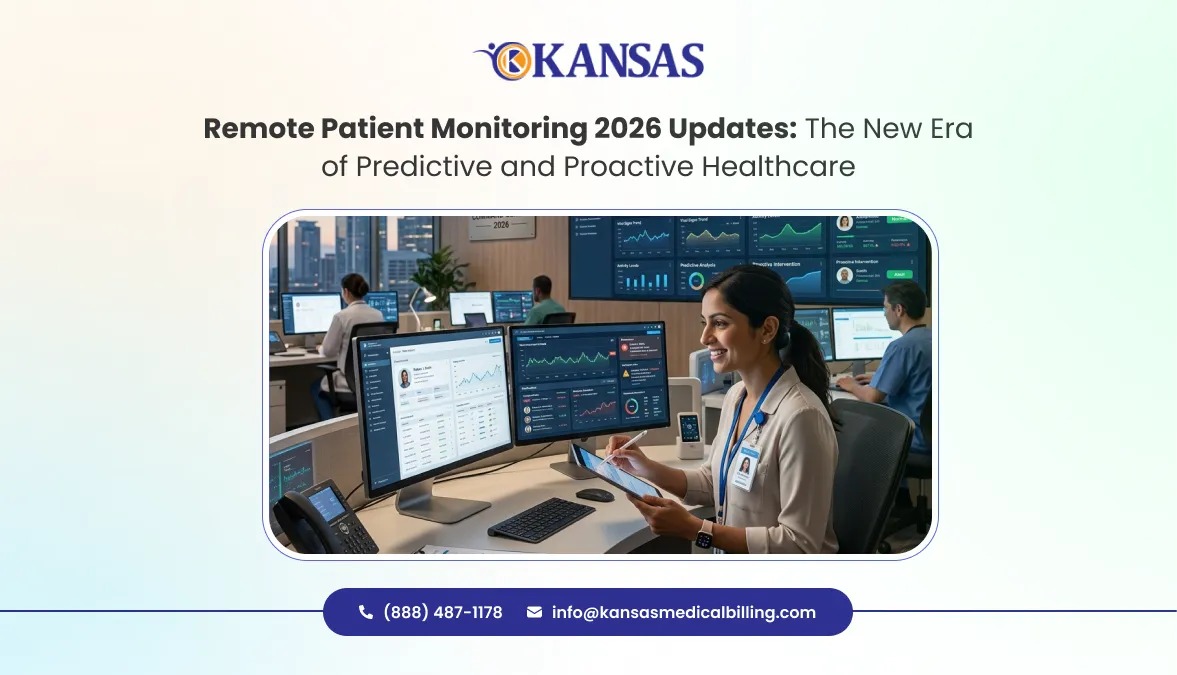
The year 2026 marks a watershed moment in the evolution of healthcare delivery. We have officially moved past the “experimental” phase of telehealth and entered an era where the home is an extension of the hospital. In 2026, Remote Patient Monitoring (RPM) has become the backbone of a modern, data-driven medical landscape. The industry has fundamentally pivoted toward predictive and proactive monitoring.
Instead of waiting for a heart failure patient to report shortness of breath, 2026 RPM systems use continuous data streams to detect “pre-clinical” physiological changes—such as a subtle decrease in heart rate variability or a minor increase in fluid retention—days before the patient experiences any symptoms. This allows clinicians to intervene early, adjust medications at home, and prevent emergency department visits altogether.
This blog will walk you through the most critical recent RPM updates, CPT codes, and documentation requirements to help you expand remote monitoring to eligible patients. We will discuss how modern technologies have revolutionized remote patient monitoring for providers. Moreover, we will shed light on the payer policies to help you submit claims on time and ensure prompt payment.
The 2026 Policy Pivot: New CPT Codes and Compliance Realities
As we move into 2026, the regulatory landscape for Remote Patient Monitoring has shifted from rigid, one-size-fits-all requirements to a more flexible, real-world framework. These updates are designed to eliminate “lost revenue” for patients who don’t require full-month monitoring, while simultaneously tightening the screws on documentation to prevent fraud.
The “Short-Duration” Breakthrough: New CPT Codes for 2026
For years, the “16-day rule” (CPT 99454) was a significant pain point, forcing practices to forfeit reimbursement if a patient missed even a few days of data transmission. In 2026, CMS officially introduced “Short-Duration” codes to bridge this gap.
CPT 99445 (The 2-15 Day Rule)
This new code allows you to bill for device supply and data transmission when a patient records between 2 and 15 days of data in 30 days. This is a game-changer for acute post-operative monitoring or medication titration, where 16 days isn’t clinically necessary.
CPT 99470 (The 10-Minute Management Code)
Previously, you couldn’t bill for care management unless you hit a full 20-minute threshold. The new 99470 code allows reimbursement for 10–19 minutes of clinical staff time, provided there is at least one interactive, real-time communication with the patient.
Technical Note
These codes are mutually exclusive. You cannot bill 99445 and 99454 for the same patient in the same month. Your billing software must be configured to “default up” to the higher-threshold code only if the data supports it.
OIG Oversight: The 2026 Compliance Standard
While CMS has made billing easier, the Office of Inspector General (OIG) has increased its scrutiny to combat “RPM Mills.” To protect your revenue from audits and recoupment, your 2026 documentation must go beyond simple data logs.
The “Prior Relationship” Mandate
OIG is specifically flagging practices that bill RPM for patients without a prior in-person or telehealth encounter. In 2026, you must document the “initiating visit” where RPM was ordered.
Substantive Management
“Ghost billing”—where a practice bills for the device (99454/99445) but not for management (99457/99470)—is now a major red flag. If you are monitoring data, you must be able to prove that a clinician actually reviewed it and made a clinical decision.
Interactive Communication Logs
For the management codes, 2026 auditors are looking for more than just a timestamp. They require documentation of a synchronous (live) interaction, such as a phone call or video chat. One-way text messages or automated portal alerts no longer satisfy the “interactive” requirement.
The 2026 Medicare Physician Fee Schedule (PFS) Updates
The 2026 Final Rule represents a strategic pivot by CMS to align reimbursement with real-world patient behavior. For the first time, Medicare has moved away from rigid “all-or-nothing” thresholds, recognizing that even short-term monitoring or brief clinical check-ins carry significant diagnostic value.
Lowered Barriers to Reimbursement: Flexibility for Acute Care
In previous years, the “16-day rule” created a significant barrier for patients who needed only temporary oversight or struggled with consistent devices consistently. The 2026 updates introduce a tiered system to support episodic and acute care, particularly in respiratory and musculoskeletal (MSK) care.
The “Golden Record” and Data Interoperability
As we move into 2026, the industry is shifting its focus from “collecting data” to “connecting data.” The goal is the creation of the “Golden Record”—a single, high-fidelity version of a patient’s health truth that follows them across the continuum of care.
Longitudinal Data: Beyond the 30-Day Snapshot
Historically, RPM data was viewed in 30-day silos, often discarded or ignored once the billing cycle ended. In 2026, the push is toward Longitudinal Data.
The Unified History: Payers and providers are now using interoperable platforms to link RPM data with historical claims and lab results.
Auditable Truth: This longitudinal view provides an “auditable history” that proves medical necessity over time, making it much harder for auditors to claim that monitoring was “not clinically indicated.”
EHR Integration: Powering the “Hospital-at-Home” Scale
The era of manual data entry is officially over. Modern API-first architectures now allow RPM data to flow directly into the Electronic Health Record (EHR) as discrete, actionable data points rather than static PDF reports.
Eliminating Manual Entry
APIs feed vitals directly into hospital databases, triggering automated alerts within the clinician’s existing workflow.
Supporting Hospital-at-Home
This seamless integration is the “engine” behind the 2026 Hospital-at-Home movement. By feeding real-time data into the EHR, hospitals can safely monitor high-acuity patients in their own bedrooms with the same level of oversight provided in a telemetry unit.
Navigating the 2026 Landscape: Compliance and Risks
The expansion of Remote Patient Monitoring (RPM) has delivered substantial clinical value but has also attracted significant regulatory scrutiny. In 2026, the mantra for providers is “Trust, but Verify.” As billing opportunities grow, so do the stakes for data integrity and clinical burnout.
The OIG Spotlight: Scrutiny on “RPM Mills”
The Department of Health and Human Services’ Office of Inspector General (OIG) has officially added RPM to its 2026 high-priority work plan. After a year where Medicare payments for RPM surpassed $500 million, federal auditors are now using advanced data analytics to flag “potential fraud” in real-time.
The “No-Relationship” Red Flag
The OIG is specifically targeting practices where a high proportion of RPM patients (often over 80%) have no prior history with the medical group. This is aimed at “RPM mills” that use cold calling and aggressive online marketing to enroll beneficiaries.
The “Device-Only” Audit
Another major trigger is billing for device supply (99454/99445) for extended periods without corresponding treatment management (99457/99470). If you collect data but do not document a clinical review, auditors may view the service as medically unnecessary.
Medical Necessity Mandate
In 2026, a “diagnosis code on a claim” isn’t enough. Auditors expect to see a signed order in the EHR documenting why this patient requires continuous monitoring for their condition.
Data Privacy: The 2026 HIPAA Convergence
Privacy in 2026 is no longer just about “encryption”; it’s about consent management across interoperable systems.
February 2026 Deadline
Healthcare organizations must meet the new enforcement deadline to update their Notices of Privacy Practices (NPPs). These updates must clearly explain how RPM data is shared through interoperable “Golden Record” systems.
The Interoperability Trap
While 2026 mandates (such as USCDI Version 3) facilitate data sharing, they also increase the “blast radius” of a potential breach. Every third-party RPM vendor you use must be meticulously vetted to ensure they aren’t just HIPAA-compliant, but “Information Blocking” compliant as well.
Solving “Alert Fatigue”: From Noise to Nuance
The most significant risk to a successful RPM program in 2026 isn’t a hacker—it’s clinician burnout. Managing 24/7 data streams for hundreds of patients can lead to “alert fatigue,” where critical red flags are missed in a sea of meaningless “noise.”
Agentic AI Triage
To solve this, the 2026 clinical standards have shifted toward Intelligent Triage. Instead of a static alert for every high reading, AI “assistants” now synthesize multiple data points (e.g., weight gain + salt intake + low activity) to generate a single, high-priority notification.
Individualized Baselines
Modern platforms have moved away from universal thresholds (like 140/90 for everyone). By learning a patient’s unique “normal,” AI reduces false positives by up to 40%, ensuring that when a nurse’s phone buzzes, it’s for a situation that truly requires their expertise.
Pro-Tip
Success in 2026 requires a “Compliance-First” EHR configuration. Ensure your software automatically links every RPM alert to a clinical note to document data review.
2026 RPM Audit Checklist: Are You Compliance-Ready?
The “Established Relationship” Verification
The OIG is currently flagging practices where >80% of RPM patients have no prior history with the group.
Initiating Visit Documentation
Do you have documentation of an in-person or telehealth encounter before RPM enrollment?
The “Order” for RPM
Is there a clear medical order in the patient’s chart signed by a practitioner (MD, DO, NP, PA) that justifies the medical necessity of the device?
Consent Forms
Is there a documented record of the patient’s verbal or written consent, including an acknowledgment of potential 20% co-insurance responsibilities?
Device & Data Transmission Standards
CMS now offers flexibility for shorter monitoring windows, but the technical requirements are stricter than ever.
FDA Medical Device Status
Can you provide documentation that your RPM devices (cuffs, scales, etc.) meet the FDA definition of a “medical device”?
Automated Uploads
Are you avoiding manual entry? Data must be digitally uploaded (Bluetooth/Cellular) from the device to the platform to be billable.
16-Day vs. 2-Day Logic
- Use CPT 99454 only for 16+ days of readings.
- Use the new CPT 99445 for 2-15 days of readings.
Audit Note
Do not “double dip” or bill the same patient for the same service in the same month.
Treatment Management (The “Substantive Review” Test)
The OIG’s biggest 2026 “red flag” is Supply-Only Billing—billing for the device month after month without billing for management time.
Management Billing (99457/99470)
Does every patient receiving a device supply code also have a corresponding management code billed? (If not, you must document why no clinical review was needed).
Interactive Communication Log
Do you have a timestamped log of at least one live, synchronous interaction (phone or video) with the patient per month?
Warning
One-way text messages or automated portal notifications do not count as interactive communication in 2026.
Evidence of Care Adjustment
Does the clinical note show that a provider actually did something with the data? (e.g., “Reviewed BP logs; adjusted Lisinopril dosage based on 7-day average of 145/95”).
Enrollment & Volume Scrutiny
The OIG’s AI monitors look for “abrupt spikes” in enrollment (150%+ growth month-over-month).
Capacity Justification
If your RPM program grew significantly this month, do you have the clinical staffing ratios to prove you actually provided the care?
Duplicate Billing Check
Have you verified the patient isn’t already enrolled in RPM with another specialty (e.g., Cardiology vs. Primary Care)? Medicare only pays one practitioner per month.
Technical Summary for 2026 Billing Codes
|
Code |
Requirement |
2026 Usage Tip |
|
99454 |
16+ days of data |
Standard chronic care monitoring. |
|
99445 |
2–15 days of data |
NEW: Use for post-op or acute episodes. |
|
99457 |
20+ mins of time |
Requires 1 live interaction. |
|
99470 |
10–19 mins of time |
NEW: Use when 20 mins isn’t reached. |
Is your practice ready for the 2026 RPM billing updates?
Don’t leave your revenue to chance under the new CMS and OIG scrutiny. Ensure your workflows are compliant, your documentation is audit-proof, and your technology is optimized for the new short-duration codes.
Kansas Medical Billing’s remote patient monitoring services comprise seasoned RPM coders and billers to get full reimbursement. Our HIPAA-compliant medical billing solutions are the backbone for thousands of medical practices across the USA. Contact us for revenue optimization.