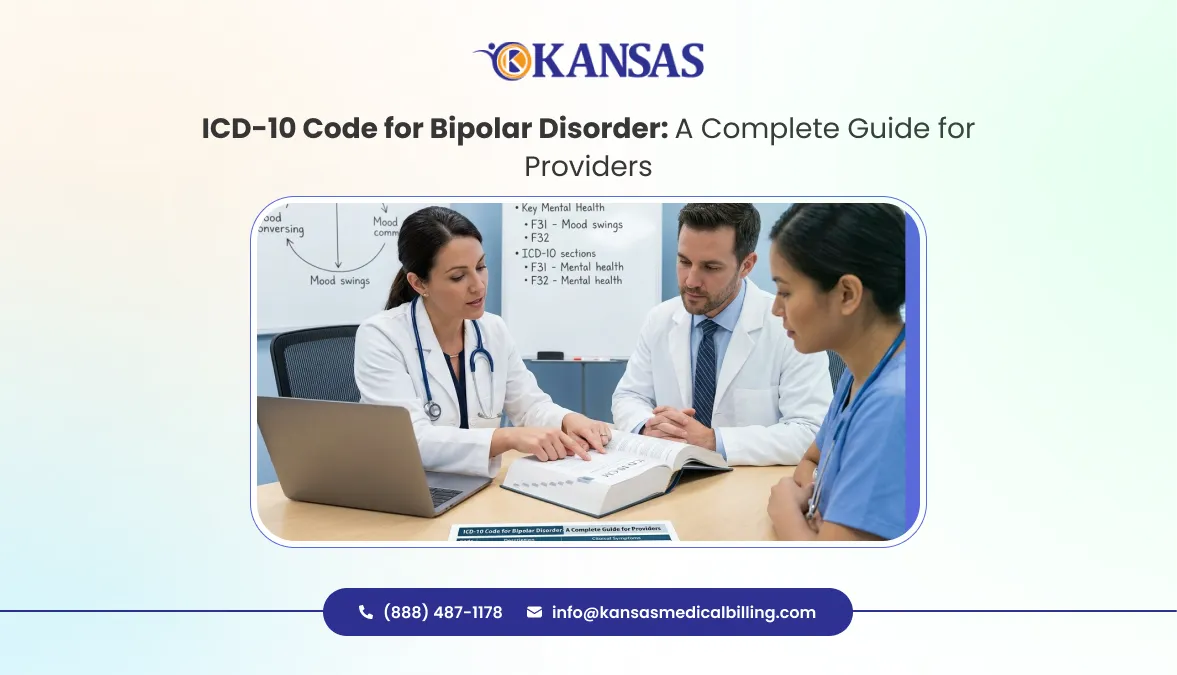
Bipolar disorder is a complicated mood condition that causes clinically significant fluctuations in mood, energy, activity, and functioning. For doctors, physicians, hospitals, and clinics, identifying bipolar disorder is just part of the patient management process. The diagnosis also must be appropriately converted into an ICD-10-CM code that represents the patient’s recorded condition as exactly as feasible.
There isn’t one ICD-10 code for bipolar disorder that’s utilized for every patient. Bipolar disorders are mainly classed as F31.- category. The correct classification is determined by the current or most recent episode, intensity, remission status and presence or absence of psychotic characteristics.
This difference is therapeutically and administratively relevant. Choosing an undefined diagnosis when the medical record supports a more specific bipolar disorder code can impair the accuracy of the patient’s longitudinal record and can lead to claim problems or medical-necessity issues.
This article will include the key ICD-10-CM codes for bipolar illness, related diagnoses, often reported CPT codes, documentation considerations, and typical reasons behavioral health claims are denied.
What Is the ICD-10 Code for Bipolar Disorder?
The principal ICD-10-CM category for bipolar disorder is F31.-, Bipolar disorder.
Within F31, individual codes identify different clinical presentations. The coding decision may rely on whether the patient is now or most recently suffering a manic, depressive, hypomanic, or mixed episode, and on severity, psychotic symptoms, and remission .
For example, a patient who has been diagnosed as bipolar I disorder, current episode manic may need a different code than a patient with bipolar I disorder with current episode depressive.
Thus, F31 should not be regarded as a diagnosis for all providers. Documentation should support the highest level billable code appropriate for the encounter.
Common ICD-10-CM Codes for Bipolar Disorder
The following table provides a practical overview of important F31.- diagnosis codes.
| ICD-10-CM Code | Diagnosis |
|---|---|
| F31.0 | Bipolar disorder, current episode hypomanic |
| F31.1 | Bipolar disorder, current episode manic without psychotic features |
| F31.2 | Bipolar disorder, current episode manic severe with psychotic features |
| F31.3 | Bipolar disorder, current episode depressed, mild or moderate severity |
| F31.4 | Bipolar disorder, current episode depressed, severe, without psychotic features |
| F31.5 | Bipolar disorder, current episode depressed, severe, with psychotic features |
| F31.6 | Bipolar disorder, current episode mixed |
| F31.7 | Bipolar disorder, currently in remission |
| F31.9 | Bipolar disorder, unspecified |
Some of these categories have additional billable subcodes. If further clarity is required, providers should report the full code that is supported by the clinical record and not the parent category that is non-billable.
Bipolar Disorder, Current Episode Hypomanic – F31.0
F31.0 is utilized when there is a proven bipolar disorder with a current hypomanic episode.
Hypomania is usually a change in mood, energy and what a person does but it is not as strong as a full manic episode. The report from the doctor needs to describe what happened and should not just focus on single signs, like trouble sleeping, being upset or having more energy.
Getting the diagnosis is very important because similar signs can show up in other mental health issues or because of medicine or because of using certain substances.
Bipolar Disorder, Current Episode Manic Without Psychotic Features – F31.1-
The F31.1- category applies to a current manic episode without psychotic features.
More specific codes include:
| Code | Description |
|---|---|
| F31.10 | Current episode manic without psychotic features, unspecified |
| F31.11 | Current episode manic without psychotic features, mild |
| F31.12 | Current episode manic without psychotic features, moderate |
| F31.13 | Current episode manic without psychotic features, severe |
This is an area where detailed documentation directly supports coding accuracy. When the physician documents severity, the diagnosis can often be represented more precisely than when the record simply states “bipolar disorder, manic.”
Bipolar Disorder, Current Episode Manic Severe With Psychotic Features – F31.2
F31.2 represents bipolar disorder with a current manic episode that is severe and accompanied by psychotic features.
The clinical record should support both the manic episode and the documented psychotic features. Depending on the patient’s presentation, these may include hallucinations, delusions, or other clinically established psychotic symptoms.
Providers should document the patient’s actual presentation rather than adding diagnostic specificity solely to obtain a more detailed code.
Bipolar Disorder, Current Episode Depressed – F31.3-
For bipolar disorder with a current depressive episode that is mild or moderate, the F31.3- category applies.
Important codes include:
F31.30 – Current episode depressed, mild or moderate severity, unspecified
F31.31 – Current episode depressed, mild
F31.32 – Current episode depressed, moderate
The contrast between bipolar depression and a unipolar depressive disorder has clinical relevance . If the patient has a known bipolar disorder, do not code for major depressive disorder just because depression is the predominating symptom at the time of the encounter.
The diagnosis documented by the treating provider should guide code selection.
Severe Bipolar Depression Without Psychotic Features – F31.4
F31.4 identifies bipolar disorder with a current depressive episode that is severe but does not include psychotic features.
Documentation should clearly establish the severity of the depressive episode and the underlying bipolar diagnosis.
The record may describe clinically relevant findings such as impaired functioning, sleep disturbance, changes in energy or activity, difficulty concentrating, or other symptoms supporting the assessment. Documentation should be individualized to the patient’s presentation rather than built around the code description.
Severe Bipolar Depression With Psychotic Features – F31.5
F31.5 is appropriate when bipolar disorder is documented with a current severe depressive episode and psychotic features.
Because psychotic symptoms can significantly affect treatment planning, level-of-care decisions, and risk assessment, their presence should be clearly documented when clinically relevant.
Providers should not select F31.5 merely because a patient has a history of psychosis. The diagnosis should accurately represent the condition being documented for the encounter.
Bipolar Disorder, Current Episode Mixed – F31.6
F31.6 describes bipolar disorder with a current mixed episode.
Mixed presentations can be clinically complicated because features associated with different mood states may occur together. The provider’s diagnostic assessment should establish the condition rather than relying on a symptom checklist for coding purposes.
Where mixed features are clinically important, the medical record should explain the patient’s presentation sufficiently to support the diagnosis.
Bipolar Disorder in Remission – F31.7-
The F31.7- family is important for patients whose bipolar disorder is documented as being in remission.
Common codes include:
| ICD-10-CM Code | Description |
|---|---|
| F31.70 | Bipolar disorder, currently in remission, most recent episode unspecified |
| F31.71 | Currently in partial remission, most recent episode hypomanic |
| F31.72 | Currently in full remission, most recent episode hypomanic |
| F31.73 | Currently in partial remission, most recent episode manic |
| F31.74 | Currently in full remission, most recent episode manic |
| F31.75 | Currently in partial remission, most recent episode depressed |
| F31.76 | Currently in full remission, most recent episode depressed |
| F31.77 | Currently in partial remission, most recent episode mixed |
| F31.78 | Currently in full remission, most recent episode mixed |
Remission should not be assumed simply because the patient’s symptoms have improved. The provider’s clinical assessment should establish whether the condition is in partial or full remission.
F31.9 – Bipolar Disorder, Unspecified
F31.9 represents bipolar disorder, unspecified.
It may be appropriate when bipolar disorder has been established. The available documentation does not support a more specific F31.- diagnosis.
However F31.9 should not become a default code when the medical record clearly identifies the episode, the severity, the psychotic features or the remission status.
For example if the physician documents ” disorder, current episode depressed, moderate ” an appropriately specific code should generally be selected rather than F31.9.
Bipolar II Disorder and ICD-10-CM
An important diagnosis within the F31 category is:
F31.81 – Bipolar II disorder
Bipolar II disorder is clinically different from bipolar I disorder and should be documented accordingly.
Providers should avoid assigning a bipolar I episode code merely because the patient has mood instability. The diagnosis should reflect the physician’s documented clinical assessment.
Other Bipolar Disorder – F31.89
F31.89 – Other bipolar disorder. This code may be appropriate if the reported bipolar disease falls within the bipolar spectrum but is better summarized by “other bipolar disorder” rather than by one of the more precisely stated F31 codes.
It should not be confused with F31.9, which represents unspecified bipolar disorder.
In practice, “other” and “unspecified” have different coding consequences. “Other” often means that the ailment is clinically described but the classification does not have a more precise dedicated code, whereas “unspecified” means that there is not enough specificity documented or available.
Related ICD-10-CM Diagnosis Codes
Having mood symptoms doesn’t mean you have bipolar disorder. Differential diagnosis is required and coding should be for the condition actually established by the treating provider.
Related ICD-10-CM categories may include:
| Code/Category | Condition |
|---|---|
| F32.- | Major depressive disorder, single episode |
| F33.- | Major depressive disorder, recurrent |
| F34.0 | Cyclothymic disorder |
| F39 | Unspecified mood [affective] disorder |
| F41.1 | Generalized anxiety disorder |
| F41.9 | Anxiety disorder, unspecified |
| F43.- | Reaction to severe stress and adjustment disorders |
| F20.- | Schizophrenia |
| F25.- | Schizoaffective disorders |
| F29 | Unspecified psychosis not due to a substance or known physiological condition |
These codes should not be added simply because they are commonly associated with behavioral health treatment. Each reported diagnosis must be clinically supported and relevant to the patient’s care.
Bipolar Disorder vs. Major Depressive Disorder Coding
One of the most important coding distinctions involves bipolar depression and major depressive disorder.
In the course of a depressive episode, patients may manifest poor mood, anhedonia, weariness, sleep trouble, difficulty concentrating and functional impairment. These data alone are not enough to decide whether the diagnosis belongs under F31, F32, or F33.
The patient’s longitudinal history and physician’s diagnostic assessment matter.
If the established diagnosis is bipolar disorder and the current episode is depressive, an appropriate F31.- code may be indicated. Major depressive disorder codes should not be substituted merely because depressive symptoms dominate the current visit.
Bipolar Disorder vs. Cyclothymic Disorder
F34.0 represents cyclothymic disorder.
Cyclothymic disorder and bipolar disorder are related mood conditions but are not interchangeable diagnoses. Providers should document the diagnosis that best reflects the patient’s clinical presentation and history.
From a claims perspective, changing between F31.- and F34.0 without supporting clinical documentation can also create inconsistencies in the patient’s medical record.
Common CPT Codes Associated With Bipolar Disorder Care
ICD-10-CM codes identify the patient’s diagnosis. CPT codes, by contrast, describe the professional service performed.
There is no single CPT code specifically for “bipolar disorder treatment.” The correct procedure code depends on what service was actually furnished.
Common behavioral health codes include:
| CPT Code | Common Use |
|---|---|
| 90791 | Psychiatric diagnostic evaluation |
| 90792 | Psychiatric diagnostic evaluation with medical services |
| 90785 | Interactive complexity add-on, when requirements are met |
| 90832 | Individual psychotherapy, approximately 30 minutes |
| 90834 | Individual psychotherapy, approximately 45 minutes |
| 90837 | Individual psychotherapy, approximately 60 minutes |
| 90833 | Psychotherapy add-on with E/M, approximately 30 minutes |
| 90836 | Psychotherapy add-on with E/M, approximately 45 minutes |
| 90838 | Psychotherapy add-on with E/M, approximately 60 minutes |
| 90839 | Psychotherapy for crisis, initial period |
| 90840 | Additional crisis psychotherapy time |
| 90846 | Family psychotherapy without the patient present |
| 90847 | Family psychotherapy with the patient present |
| 90853 | Group psychotherapy |
CMS recognizes 90791 and 90792 as psychiatric diagnostic evaluation codes and the 90832–90838 family for psychotherapy services. The psychotherapy codes are time dependent, so the documentation needs to support the service and applicable time requirements.
E/M Codes for Physicians Treating Bipolar Disorder
Doctors and other qualified practitioners may also use applicable evaluation and management codes when the encounter meets E/M requirements.
Common office/outpatient E/M codes include:
99202–99205 for new patients and
99211–99215 for established patients, as applicable.
A medication-management follow-up for bipolar disorder, for example, may involve an E/M service when the documentation and circumstances support it.
If psychotherapy is properly performed during an E/M contact, the following psychotherapy add-on codes may apply: 90833, 90836 or 90838.
Providers should be aware that these psychotherapy add-on codes are not automatically included to medication-management appointments. Psychotherapy must actually be provided, separately identifiable, medically necessary, and properly documented.
CMS guidance recognizes 90833, 90836, and 90838 as psychotherapy add-on services used with qualifying E/M services.
Psychiatric Diagnostic Evaluation: 90791 vs. 90792
A common point of confusion is the distinction between 90791 and 90792.
CPT 90791 represents a psychiatric diagnostic evaluation, while 90792 represents a psychiatric diagnostic evaluation with medical services.
The appropriate code depends on the actual service performed and the practitioner’s scope and documentation.
CMS also states that psychiatric diagnostic procedures generally should not be reported on the same day as an E/M service performed by the same individual for the same patient.
Providers should therefore avoid automatically pairing an E/M code with 90791 or 90792.
Psychotherapy Time Documentation
Time is particularly important when billing psychotherapy.
CMS guidance identifies the following general time ranges for psychotherapy codes:
| CPT Code | CMS-Referenced Time Range |
|---|---|
| 90832 / 90833 | 16–37 minutes |
| 90834 / 90836 | 38–52 minutes |
| 90837 / 90838 | 53 minutes or more |
For psychotherapy codes, the medical record should support the actual psychotherapy time. CMS guidance specifically expects start/stop times or total psychotherapy time for applicable services.
A note that simply states “psychotherapy performed” without supporting the time and therapeutic service may be insufficient for a time-based psychotherapy claim.
Crisis Psychotherapy Codes
Patients experiencing severe mood episodes may occasionally require crisis-oriented psychotherapy.
Applicable codes include:
90839 – psychotherapy for crisis, first 60 minutes
90840 – each additional 30 minutes
These codes have their own billing requirements and should not simply be added to a routine psychotherapy visit.
CMS specifically instructs providers not to bill psychotherapy-for-crisis codes together with certain psychiatric diagnostic and psychotherapy codes for the same service.
Documentation Requirements for Bipolar Disorder
Good documentation should tell the patient’s clinical story without reading like a coding checklist.
For bipolar disorder, a useful record generally identifies the established diagnosis and clinically relevant details necessary to support its specificity.
Depending on the encounter, documentation may address the patient’s current or most recent episode, symptom course, severity, psychotic symptoms when present, remission status, functional impact, medication management, response to treatment, relevant risk assessment, psychotherapy provided, and follow-up plan.
For a psychotherapy service, the record should additionally support the psychotherapy intervention and applicable time.
For E/M services, documentation should satisfy the requirements for the E/M level selected.
The goal is not to document more words. It is to document enough meaningful clinical information to demonstrate what condition was treated, what service was provided, and why that service was medically necessary.
Example of Specific Bipolar Disorder Coding
Consider a patient with an established bipolar diagnosis who presents with a current depressive episode.
If the physician documents only:
“Bipolar disorder.”
the record may not support much diagnostic specificity.
If the clinical assessment instead establishes:
“Bipolar disorder, current episode depressed, moderate.”
the documentation provides substantially more information for selecting the appropriate diagnosis code.
Similarly, documenting whether psychotic features are present or whether the condition is in remission can materially affect code selection.
The diagnosis should always emerge from the clinical assessment—not from a desire to reach a particular billing code.
Common Claim Denials Involving Bipolar Disorder Services
Even when the diagnosis itself is valid, behavioral health claims may be denied because the diagnosis, procedure, documentation, or payer requirements do not align.
Incorrect or Unsupported ICD-10-CM Code
A claim may encounter problems when the submitted F31.- code contains specificity that is not supported by the medical record.
For example, reporting a code indicating severe bipolar depression with psychotic features requires documentation supporting that clinical presentation.
The solution is straightforward: code from the physician’s documented diagnosis rather than selecting a code based on reimbursement expectations.
Medical Necessity Not Supported
A payer may question why a particular service was medically necessary for the documented condition.
The note should establish the clinical reason for the encounter, relevant assessment, treatment delivered, and plan.
CMS requires the diagnosis reported on the claim to best describe the patient’s condition for which the service was performed.
Psychotherapy Time Is Missing
Because many psychotherapy codes are time based, incomplete time documentation can create a significant claim vulnerability.
Providers should ensure that the record includes the information required by the payer for the selected psychotherapy code, including applicable total time or start-and-stop time documentation.
Incorrect CPT Combination
Another problem occurs when incompatible or inappropriate services are reported together.
For example, psychotherapy add-on codes such as 90833, 90836, and 90838 are designed to accompany appropriate E/M services rather than being reported as independent psychotherapy codes.
Likewise, CMS applies coding edits and specific restrictions to combinations of psychiatric services.
Repeated Psychiatric Diagnostic Evaluations
Repeated use of 90791 or 90792 may receive scrutiny when the documentation does not explain why another diagnostic evaluation was necessary.
CMS notes that psychiatric diagnostic procedures may generally be used at the outset of an illness or suspected illness and may be appropriate again in circumstances such as a new episode after a hiatus or certain readmissions. When more than one diagnostic interview is required, the medical record should support why.
Prior Authorization or Payer Requirements
Behavioral health benefits vary among Medicare, Medicaid, Medicare Advantage, and commercial health plans.
Certain services may be subject to authorization, network, frequency, provider-type, telehealth, place-of-service, or other plan-specific rules.
A code being valid does not automatically mean that a payer will cover the service.
Providers should verify the patient’s benefits and the payer’s current coverage requirements before treatment whenever appropriate.
Provider Eligibility Issues
Claims may also be affected when the service is performed or billed by a professional who does not meet the payer’s requirements for that particular service.
Credentialing, enrollment, taxonomy, state scope-of-practice requirements, and payer policies should therefore be verified.
Duplicate Claims
Submitting the same date of service, patient, procedure, and provider information more than once can trigger a duplicate denial.
Before resubmitting an unpaid behavioral health claim, providers should first determine whether the original claim was rejected, denied, suspended, or simply still being processed.
Avoiding Bipolar Disorder Coding Errors
Accurate coding begins with accurate clinical documentation.
Physicians should distinguish among manic, hypomanic, depressive, mixed, and remission presentations when the diagnosis supports those distinctions. Psychotic features and severity should be documented when clinically relevant.
Clinics should also avoid automatically carrying forward an old diagnosis without confirming that it remains an accurate representation of the patient’s current clinical status.
A patient whose bipolar disorder is now documented in remission may require different diagnostic specificity from the code used during an active episode.
Likewise, F31.9 should not remain on every claim simply because it was initially entered into the patient’s chart.
Why Diagnosis-to-Service Alignment Matters
A claim tells a clinical story in coded form.
The ICD-10-CM diagnosis explains why the patient required care, while the CPT or HCPCS code identifies what service was delivered.
When these pieces do not align, payers may question medical necessity.
For example, a high-intensity behavioral health service accompanied by vague diagnostic documentation may attract additional review. Conversely, highly specific diagnostic coding unsupported by the clinical note can create another type of compliance concern.
Strong documentation connects the assessment, diagnosis, intervention, and plan in a logical sequence.
ICD-10-CM Updates for 2026 and 2027
Providers should verify the code set applicable to the patient’s date of service, rather than relying indefinitely on an old code list.
CDC/NCHS maintains ICD-10-CM for diagnosis coding in the United States. For services provided from April 1 through September 30, 2026, the applicable April 2026 release should be consulted. The FY 2027 ICD-10-CM release becomes applicable October 1, 2026 and runs through September 30, 2027.
This is especially important for hospitals and multi-provider clinics that maintain internal diagnosis favorites, templates, EHR pick lists, or automated coding rules.
Those resources should be reviewed when code-set updates take effect.
Practical Coding Example
Suppose a physician sees an established patient with bipolar disorder for medication management.
The physician evaluates the patient’s current symptoms, medication response, adverse effects, functional status, and treatment plan. The record establishes bipolar disorder with a specific current episode.
The diagnosis code should reflect that documented presentation.
If the physician also performs a distinct psychotherapy service that meets the requirements for a psychotherapy add-on code, the applicable E/M service and psychotherapy add-on may potentially be reported when all requirements are satisfied.
If psychotherapy was not actually performed, however, a psychotherapy code should not be added simply because counseling occurred during the medical visit.
CMS explicitly notes that psychotherapy should not be billed when the service is more accurately characterized as E/M or another service.
Quick Reference: Bipolar Disorder Codes
| Clinical Documentation | ICD-10-CM Code/Family |
|---|---|
| Current episode hypomanic | F31.0 |
| Current episode manic without psychotic features | F31.1- |
| Current episode manic, severe, with psychotic features | F31.2 |
| Current episode depressed, mild/moderate | F31.3- |
| Current episode depressed, severe, without psychotic features | F31.4 |
| Current episode depressed, severe, with psychotic features | F31.5 |
| Current episode mixed | F31.6 |
| Currently in remission | F31.7- |
| Bipolar II disorder | F31.81 |
| Other bipolar disorder | F31.89 |
| Bipolar disorder, unspecified | F31.9 |
Final Thoughts
Selecting the correct ICD-10 code for bipolar disorder requires more than locating F31 in a code list. Accurate coding depends on translating the physician’s clinical assessment into the most appropriate diagnosis code while preserving distinctions such as the current episode, severity, psychotic features, and remission status.
For doctors, physicians, hospitals, and clinics, the most reliable approach is to make documentation clinically meaningful first and allow coding specificity to follow from that documentation.
The same principle applies to procedure coding. Psychiatric diagnostic evaluations, psychotherapy, crisis services, family psychotherapy, and E/M encounters each have different CPT requirements. A valid bipolar disorder diagnosis does not by itself establish that a particular procedure is covered or medically necessary.
Before submitting a claim, providers should confirm that the diagnosis matches the medical record, the procedure accurately represents the service performed, time-based services contain adequate time documentation, required modifiers and place-of-service information are correct, and payer-specific coverage or authorization requirements have been satisfied.
With consistent diagnosis-to-service alignment and current code-set verification, healthcare organizations can maintain cleaner clinical records while reducing preventable behavioral health claim denials.
Frequently Asked Questions About the ICD-10 Code for Bipolar Disorder
What is the main ICD-10 code for bipolar disorder?
Bipolar disorder is primarily classified within the F31.- ICD-10-CM category. The complete code depends on the documented type and clinical presentation.
What is the ICD-10 code for unspecified bipolar disorder?
F31.9 represents bipolar disorder, unspecified. It should generally be used when the diagnosis is established but the available documentation does not support a more specific bipolar disorder code.
What is the ICD-10 code for bipolar II disorder?
The ICD-10-CM code for bipolar II disorder is F31.81.
What is the ICD-10 code for bipolar disorder in remission?
Bipolar disorder in remission falls under the F31.7- family. The specific code depends on whether remission is partial or full and, where specified by the classification, the most recent episode.
Are bipolar disorder and depression coded the same way?
No. Bipolar disorder generally falls under F31.-, while major depressive disorders are represented by other ICD-10-CM categories such as F32.- and F33.-. Code selection should follow the diagnosis established and documented by the treating provider.
Can F31.9 be used for every bipolar patient?
No. F31.9 is an unspecified code. When the clinical record supports greater specificity regarding the bipolar disorder presentation, providers should select the appropriate more-specific ICD-10-CM code.
Which CPT code is used for bipolar disorder?
There is no single CPT code for bipolar disorder itself. CPT codes describe services rather than the diagnosis. Depending on the encounter, applicable codes may include 90791, 90792, 90832, 90834, 90837, 90833, 90836, 90838, 90839, 90840, or an appropriate E/M code.