
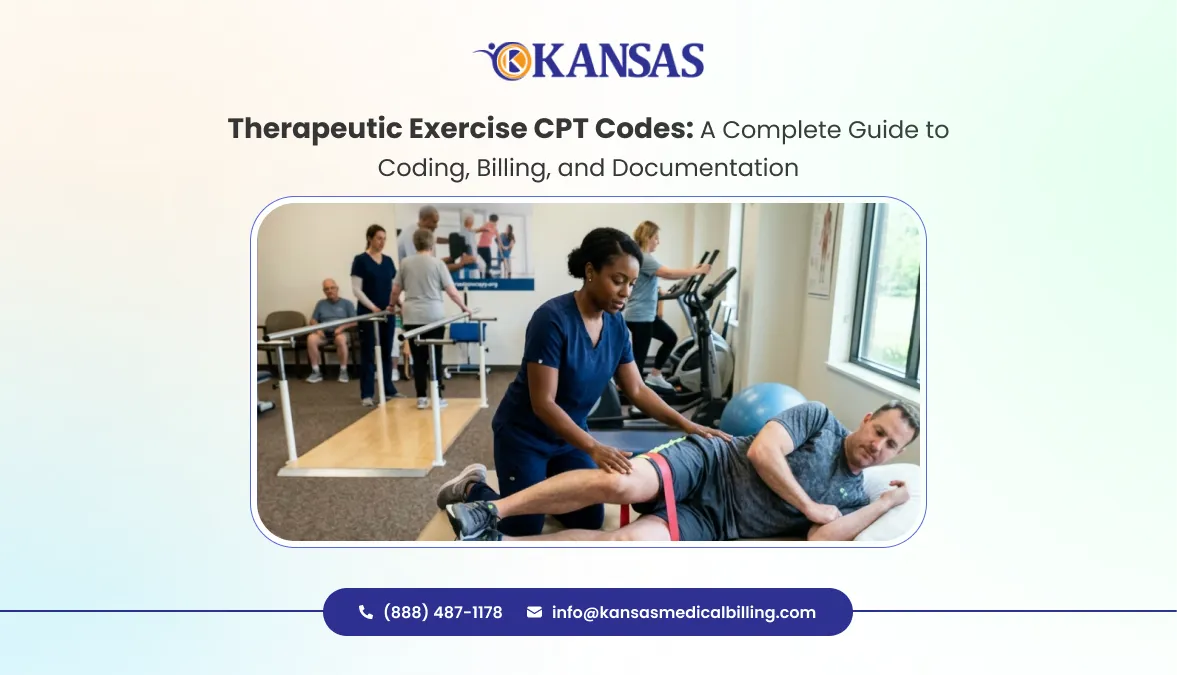
Although therapeutic exercise is a part of rehabilitation billing for therapeutic exercise is not always as simple, as showing that a patient exercised during a session. The therapeutic exercise must support functional goals have a clear therapeutic purpose require the expertise of a qualified healthcare professional and be documented well enough to justify the CPT code and the number of units billed.
Therapeutic exercise CPT codes matter a lot to physicians, hospitals, outpatient clinics, rehabilitation practices and other healthcare providers. These codes are important when the services include things, like strengthening exercises range-of-motion work, flexibility training, endurance training, neuromuscular retraining, gait training, manual therapy or functional activities—all done during the visit.
CPT Code for Therapeutic Exercise is 97110. Depending on the treatment and reason other codes, like 97112, 97113, 97116 97140, 97530 and 97535 may also be used.
The correct code should match the therapy given. It should not be based on the equipment used. Simply because the patient was doing exercise. The coding must reflect the intervention that took place.
This resource gives details, about therapeutic exercise CPT coding. It includes the ICD-10-CM codes that apply how to bill using timed units what documentation is required, which modifiers to use and common reasons claims get denied. The goal is to help physicians support compliant reimbursement.
What Is the CPT Code for Therapeutic Exercise?
CPT 97110 is the primary therapeutic exercise code.
It represents individually provided therapeutic exercises intended to improve areas such as strength, endurance, range of motion, or flexibility. It is reported in 15-minute units.
CMS advice expressly identifies CPT 97110 when performing exercises to restore functional strength, range of motion, endurance or flexibility. For example, the use of a gym ball during an activity does not dictate the code; if the therapeutic objective is to improve strength and the code standards are completed, 97110 may be suitable.
This distinction matters a deal. Many rehabilitation interventions look the same at sight. One patient can move like another patient yet the correct CPT code can still be different. That difference comes from the goal and the skilled intervention, which are not the same.
Therapeutic Exercise CPT Code 97110 Explained
Typically, CPT 97110 is used when a health care provider does therapeutic exercises aimed at improving identified, measurable physical limitations.
Common clinical goals are to increase muscle strength restore motion increase flexibility improve muscular endurance get back movement after surgery or injury and help the patient become more independent.
For example a patient recovering from knee surgery may do quadriceps strengthening active range‑of‑motion exercises, resisted knee extension and lower‑extremity flexibility activities. CPT 97110 may be justified when these treatments are performed competently are medically mandatory are done one‑on‑one and are recorded.
Simply asking a patient to independently complete a routine exercise program usually does not establish medical necessity for skilled therapy. The record should demonstrate why professional judgment, instruction, progression, modification, monitoring, or correction was necessary.
CMS guidance also emphasizes that the record should describe changes or additions to the exercise program when appropriate. The record should also show progression toward an caregiver-assisted home exercise program when clinically indicated.
Most Relevant Therapeutic Exercise and Rehabilitation CPT Codes
Several CPT codes are commonly encountered alongside 97110. Although they can be part of the same overall plan of care, they describe different therapeutic purposes.
| CPT Code | Common Clinical Use | Billing Basis |
|---|---|---|
| 97110 | Therapeutic exercise for strength, endurance, ROM, or flexibility | Each 15 minutes |
| 97112 | Neuromuscular re-education addressing areas such as balance, coordination, posture, or proprioception | Each 15 minutes |
| 97113 | Therapeutic procedures performed in an aquatic environment | Each 15 minutes |
| 97116 | Gait-training intervention | Each 15 minutes |
| 97140 | Manual therapy techniques | Each 15 minutes |
| 97530 | Therapeutic activities using functional, dynamic tasks | Each 15 minutes |
| 97535 | Self-care/home-management training | Each 15 minutes |
| 97150 | Group therapeutic procedures | Per session under applicable coding rules |
| 97161–97163 | Physical therapy evaluations based on applicable complexity level | Untimed evaluation codes |
| 97164 | Physical therapy re-evaluation | Untimed |
| 97165–97167 | Occupational therapy evaluations based on complexity | Untimed evaluation codes |
| 97168 | Occupational therapy re-evaluation | Untimed |
CMS lists 97110, 97112, 97113, 97116, 97140, 97530, 97535 and several additional codes as therapeutic intervention codes where the treatment plan and documentation should support the specified purpose of each therapy.
Providers should not select a code only because it seems to be frequently reimbursed. The procedure performed and its clinical aim must be supported by the reported code.
CPT 97110 vs. 97530: What Is the Difference?
One of the most prevalent sources of confusion is the difference between CPT code for therapeutic exercise 97110 and CPT code for therapeutic activities 97530.
CPT 97110 is generally for exercise geared toward impaired level goals such as strength, flexibility, endurance and range of motion.
CPT 97530 often includes active activities aimed at enhancing functional performance.
Consider a patient who has just sustained an injury to a lower extremity.
97110 can be supported by doing a resisted knee extension to develop quadriceps strength
If the purpose of the intervention is to increase functional performance, it may be more appropriate to assist 97530 through repeated functional lifting, carrying, squatting, reaching, or task-specific transfers.
The documentation should make that distinction clear.
Writing only:
“Patient completed strengthening and functional exercises.”
does not explain enough.
A stronger treatment note would connect the intervention to the impairment, skilled progression, and functional objective.
CPT 97110 vs. 97112
CPT 97112 applies to neuromuscular re-education rather than conventional therapeutic strengthening or flexibility exercises.
Neuromuscular re-education may be appropriate when the clinical focus involves balance, coordination, proprioception, posture, kinesthetic awareness, or motor control.
For example, strengthening the hip abductors with progressively increased resistance may support CPT 97110.
Standing on an unstable surface while receiving skilled cueing to improve proprioceptive control following an ankle injury may support CPT 97112, depending on the circumstances and payer requirements.
The clinical purpose determines the code.
Using a balance board does not automatically make an intervention 97112, just as using resistance bands does not automatically make an intervention 97110.
CPT 97110 vs. 97116
CPT 97116 is associated with gait training.
97116 may be more appropriate than therapeutic exercise when the clinician is explicitly addressing walking mechanics, gait sequencing, assistive-device use, stair-related gait abilities, weight shifting during ambulation, or other skilled gait components.
A patient may receive both therapeutic exercise and gait training during one appointment.
For example, the provider might spend part of the session strengthening the lower extremities under 97110 and a separate part of the session correcting gait mechanics under 97116.
When multiple timed codes are reported, however, the total minutes and the allocation of units must comply with the applicable payer’s timed-service methodology.
CPT 97110 vs. 97140
CPT 97140 generally represents manual therapy techniques.
97110 is utilized for therapeutic exercise goals such as developing strength , flexibility , endurance and range of motion . Manual interventions may be utilized for joint mobility , soft tissue limits or other impairments found .
For example, a patient with shoulder dysfunction may be treated with skillful manual therapy followed by active therapeutic activity.
The treatment documentation should distinguish the procedures and record the minutes associated with each timed service.
Providers should also review applicable National Correct Coding Initiative edits whenever multiple therapy procedures are billed together.
How Does the Medicare 8-Minute Rule Work for Therapeutic Exercise?
CPT 97110 is a timed code billed in 15-minute increments.
For Medicare Part B therapy services, the number of timed units is based on the total timed treatment minutes furnished during the calendar day.
The general Medicare timed-unit ranges include:
| Total Timed Treatment Minutes | Maximum Timed Units |
|---|---|
| 8–22 minutes | 1 unit |
| 23–37 minutes | 2 units |
| 38–52 minutes | 3 units |
| 53–67 minutes | 4 units |
| 68–82 minutes | 5 units |
| 83–97 minutes | 6 units |
| 98–112 minutes | 7 units |
| 113–127 minutes | 8 units |
CMS explains that total timed-code minutes determine the total number of units available. When multiple timed procedures are provided, those units are allocated according to the time spent furnishing each service.
Example: Therapeutic Exercise Only
Suppose a patient receives 30 minutes of CPT 97110.
Thirty minutes falls within the Medicare range supporting two timed units.
Therefore, assuming all other requirements are satisfied, the provider could report:
97110 × 2 units
Example: Therapeutic Exercise and Manual Therapy
Suppose treatment includes:
33 minutes of therapeutic exercise under 97110 and 7 minutes of manual therapy under 97140.
The total timed treatment is 40 minutes, which supports three units.
CMS gives this type of example and allocates two units to 97110 and one unit to 97140.
Example: Multiple Therapy Procedures
CMS also provides an example involving:
18 minutes of therapeutic exercise, 13 minutes of manual therapy, 10 minutes of gait training, and 8 minutes of ultrasound.
The total timed treatment is 49 minutes, supporting three timed units—not four. Under CMS’s example, the three units are assigned to 97110, 97140, and 97116 because those services account for the appropriate allocation of billable timed treatment.
The important lesson is that providers should not calculate every timed CPT code independently and then add all rounded units together.
The total billable units are constrained by the total timed treatment minutes.
Commercial plans, Medicare Advantage plans, Medicaid programs workers compensation programs and other payers may use methods, for calculations. Providers should therefore verify the patient’s payer policy instead of assuming Medicare’s calculation method applies universally.
Untimed Codes Should Not Be Added to Timed-Code Minutes
Physical and occupational therapy evaluations are generally untimed services.
For example, if a clinician performs an occupational therapy evaluation followed by therapeutic exercise, the evaluation minutes are not added to the therapeutic exercise minutes when calculating Medicare timed treatment units.
CMS gives an example involving a 35-minute OT evaluation, 25 minutes of therapeutic exercise, and 8 minutes of therapeutic activity. Only the 33 minutes associated with timed procedures are used to determine timed units; the evaluation remains separately reportable as an untimed service when applicable.
This distinction can prevent accidental overbilling.
Relevant ICD-10-CM Codes for Therapeutic Exercise
There is no single ICD-10 code for therapeutic exercise.
The diagnosis code should represent the patient’s documented condition, impairment, symptom, injury, postoperative state, or other reason the therapeutic service is medically necessary.
Examples frequently associated with rehabilitation include:
| ICD-10-CM Code | Diagnosis |
|---|---|
| M62.81 | Generalized muscle weakness |
| M25.561 | Pain in right knee |
| M25.562 | Pain in left knee |
| M25.511 | Pain in right shoulder |
| M25.512 | Pain in left shoulder |
| M25.551 | Pain in right hip |
| M25.552 | Pain in left hip |
| M25.661 | Stiffness of right knee |
| M25.662 | Stiffness of left knee |
| R26.2 | Difficulty walking, not elsewhere classified |
| R26.81 | Unsteadiness on feet |
| R26.89 | Other abnormalities of gait and mobility |
| R27.8 | Other lack of coordination |
| R29.3 | Abnormal posture |
| R25.2 | Cramp and spasm |
CMS coverage materials for outpatient physical therapy include diagnoses such as M25.561, M25.562, M62.81, R26.2, R26.81, R26.89, and other musculoskeletal or mobility-related conditions among potentially relevant diagnoses.
These codes are examples rather than an automatic list of diagnoses supporting 97110.
The provider should select the diagnosis that accurately reflects the medical record and medical necessity of the particular treatment.
Diagnosis Coding Must Match the Clinical Problem
A diagnosis should not be selected simply because it appears on a payer’s coverage list.
For example, consider a patient receiving therapeutic exercises following knee surgery.
Documentation may show knee discomfort, stiffness of the joints, weakness, decreased range of motion or other postoperative disability. The stated diagnosis should reflect the patient’s documented clinical circumstances appropriately and in accordance with ICD-10-CM coding criteria.
Laterality should also be captured when available.
If the provider documents right knee pain, M25.561 is more specific than an unspecified knee-pain diagnosis.
Similarly, right shoulder pain and left shoulder pain have separate ICD-10-CM codes.
Specific documentation reduces unnecessary ambiguity and may help prevent diagnosis-related claim denials.
Important 2026–2027 ICD-10-CM Timing
Providers should pay particular attention to the ICD-10-CM update cycle during late 2026.
Currently, the FY 2026 ICD-10-CM files are applicable to patient contacts through September 30, 2026, CMS explains. FY 2027 ICD-10-CM files are effective for patient interactions from October 1, 2026, through September 30, 2027.
Because code additions, revisions, and deletions may occur during the annual update, hospitals and clinics should verify the applicable diagnosis code set based on the patient’s date of service.
Documentation Requirements for CPT 97110
Good therapeutic exercise documentation should answer a simple question:
Why did this patient require skilled therapeutic exercise today?
A strong treatment record connects the diagnosis, impairment, intervention, time, skilled involvement, and functional goal.
Documentation of therapeutic exercise should generally identify the exercises or interventions performed, the body region being treated, the therapeutic objective, the level of resistance or progression when applicable, the patient’s response, skilled cueing or modification provided, total direct treatment time, timed-code minutes, progress toward established goals, and the plan to continue or change treatment.
CMS specifically notes that documentation supporting 97110 should demonstrate the therapeutic purpose of the exercises. Medicare guidance also expects exercises to be progressed or transitioned toward an independent or caregiver-assisted home program when appropriate.
A note such as:
There ex performed for 30 minutes. Patient tolerated well.
provides relatively little information regarding medical necessity or skilled care.
A stronger clinical record would establish why specific exercises were selected, how they were progressed or modified, what impairment they addressed, and how the intervention relates to a measurable functional outcome.
Connect Therapeutic Exercise to Functional Goals
One of the most important elements of therapy documentation is the relationship between the intervention and the patient’s functional limitations.
Suppose a patient has reduced quadriceps strength following knee surgery.
Instead of simply documenting “lower-extremity strengthening,” the record should show why the strength deficit matters functionally.
The goal might involve safely negotiating stairs, rising independently from a chair, increasing walking tolerance, returning to work activities, or performing household mobility.
This connection helps demonstrate why the treatment requires skilled rehabilitation services rather than a general fitness program.
Show Progression of the Exercise Program
Repeatedly providing the same exercise program without documented progression may create questions regarding the continuing need for skilled treatment.
CMS guidance specifically notes that documentation should describe new exercises or changes in the exercise program when appropriate and should demonstrate transition toward independent performance when clinically indicated.
Progression could involve increased resistance, increased repetitions, altered range, greater movement complexity, reduced support, advanced balance challenge, revised movement strategy, increased endurance demand, or changes based on the patient’s response.
The record should reflect clinical reasoning rather than simply documenting completion of exercises.
Medical Necessity and Skilled Therapy
Coverage for therapeutic exercise generally depends on more than the existence of pain or weakness.
The services should require the knowledge and skills of a qualified professional and should be reasonable and necessary for the patient’s condition.
A patient who can safely perform an unchanged exercise program independently may eventually no longer require skilled intervention for that same activity.
By contrast, ongoing skilled care may remain medically necessary when the clinician is evaluating the patient’s response, modifying treatment because of changes in symptoms or function, advancing the exercise program, correcting movement patterns, managing clinical precautions, or providing other skilled services that cannot reasonably be performed independently.
Medicare Therapy Modifiers
Therapy claims may require modifiers depending on the discipline and circumstances.
Common therapy-related modifiers include:
| Modifier | General Application |
|---|---|
| GP | Services delivered under a physical therapy plan of care |
| GO | Services delivered under an occupational therapy plan of care |
| GN | Services delivered under a speech-language pathology plan of care |
| KX | Used when applicable Medicare therapy threshold requirements are met and continued services are medically necessary |
| CQ | Certain PT services furnished in whole or in part by a physical therapist assistant |
| CO | Certain OT services furnished in whole or in part by an occupational therapy assistant |
| 59 | Distinct procedural service when appropriate and supported |
| XE/XP/XS/XU | More specific NCCI-associated modifiers when applicable |
Modifier requirements depend on payer rules and the circumstances of the service.
They should not be automatically appended simply to obtain payment.
2026 Medicare KX Modifier Threshold
For calendar year 2026, CMS set the KX threshold at $2,480 for physical therapy and speech-language pathology services combined and $2,480 separately for occupational therapy services.
The KX modifier indicates that the provider attests that services exceeding the applicable threshold remain medically necessary and that supporting documentation is present in the patient’s record.
This is particularly important because CMS approved a 2026 Recovery Audit Contractor review concerning therapy claims billed with the KX modifier. The review examines medical necessity, coding requirements, documentation, and appropriate modifier use and specifically includes codes such as 97110, 97112, 97116, 97140, 97530 and others.
Therefore, the KX modifier should not be treated as a routine administrative addition to every claim above the threshold.
Documentation needs to support why continued skilled treatment remains medically necessary.
CQ and CO Modifiers
Medicare also has specific rules when physical therapist assistants and occupational therapy assistants participate in furnishing therapy services.
CMS provides detailed calculations for determining when the CQ modifier applies to PT services furnished in whole or in part by a PTA and when the corresponding CO modifier applies for OTA services.
For example, CMS provides a scenario in which a PTA furnishes 10 minutes of 97110 and the PT furnishes five minutes. One unit is billable, and the CQ modifier applies under CMS’s de minimis methodology.
Because assistant involvement can affect claim reporting and payment, providers should carefully document who furnished each portion of treatment.
NCCI Edits and Modifier 59
Some combinations of rehabilitation codes may be subject to NCCI procedure-to-procedure edits.
A modifier such as 59 should not be appended merely because two procedures were performed on the same day.
It indicates that the procedures meet the requirements for being considered distinct under the applicable coding rules.
CMS emphasizes that modifiers associated with NCCI edits should only be used when the circumstances support their use. More specific X modifiers—XE, XP, XS, or XU—may sometimes be appropriate depending on payer requirements and the nature of the distinct service.
The treatment note should clearly establish what was done, when it was done, and why each separate procedure was medically necessary.
Common Therapeutic Exercise Claim Denials
Therapeutic exercise claims can be denied even when the service itself was clinically appropriate.
Insufficient Documentation
A note that lists “therapeutic exercise” without identifying the clinical objective, skilled intervention, time, or patient response may not adequately support 97110.
The record should demonstrate why skilled therapeutic treatment was medically necessary.
Incorrect Number of Units
Unit errors are especially common with 15-minute timed CPT codes.
For Medicare, the number of units should be supported by the total timed treatment minutes.
Submitting four units when the documented total supports only three can result in denial, recoupment, or audit exposure.
Diagnosis Does Not Support Medical Necessity
The ICD-10-CM diagnosis reported should reasonably correspond with the condition or impairment being treated.
If the diagnosis submitted does not support the therapeutic intervention—or conflicts with the clinical record—the payer may question medical necessity.
Missing GP or GO Modifier
Depending on the payer and billing circumstances, failing to append the applicable therapy-plan modifier can result in claim rejection or denial.
Providers should verify whether GP, GO, or another modifier is required.
Incorrect Use of Modifier 59
Modifier 59 should not be used simply to bypass an NCCI edit.
The record must support that the services qualify as distinct according to the applicable coding rules.
Time Does Not Support the Units
If the treatment note documents 20 minutes of 97110 but the claim reports two units, Medicare’s timed-service methodology would not support the units billed.
The documentation and claim should agree.
Duplicate Services
Claims may be denied when the payer believes the same service was reported twice or when multiple procedures appear to describe the same treatment.
Detailed documentation distinguishing each intervention is especially important when several rehabilitation codes are billed during one encounter.
Maximum Benefit or Lack of Measurable Progress
Long courses of treatment without documented functional improvement, justified maintenance needs, or changes in the treatment program can trigger payer scrutiny.
CMS notes that extended treatment producing only small changes may not necessarily demonstrate meaningful functional progress.
Authorization Problems
Commercial plans and managed care programs may require prior authorization or limit the number of therapy visits.
A clinically appropriate service may still be denied if authorization requirements are not satisfied.
Eligibility, benefits, visit limits, authorization dates, and payer requirements should therefore be checked before treatment whenever possible.
Common Denial Codes Providers May Encounter
Therapeutic exercise denials may be accompanied by Claim Adjustment Reason Codes or Remittance Advice Remark Codes.
The exact CARC or RARC depends on the payer and reason for adjudication, but issues commonly involve medical necessity, noncovered services, missing authorization, incorrect modifiers, bundled procedures, frequency limitations, duplicate billing, or documentation requests.
Providers should use the actual remittance advice rather than assuming every 97110 denial has the same cause.
For example, an NCCI-related denial requires a very different response from a denial caused by exhausted therapy benefits.
A strong denial workflow begins by identifying the actual payer reason, reviewing the clinical note and claim, determining whether the original coding was correct, and correcting or appealing only when the documentation supports the action.
Example of Therapeutic Exercise Coding
Consider a patient attending outpatient therapy following right knee surgery.
The examination identifies reduced knee range of motion, quadriceps weakness, and difficulty using stairs.
During one session, the clinician provides progressive resisted quadriceps exercises, active range-of-motion work, and flexibility training for 30 minutes. The clinician modifies resistance based on pain and movement quality and documents improvement in strength and stair performance.
Depending on the complete record and payer requirements, the claim might include CPT 97110 for two units, with an appropriate diagnosis reflecting the patient’s documented knee condition, weakness, stiffness, postoperative status, or another supported diagnosis.
If the clinician also spends a separate period working specifically on gait mechanics, CPT 97116 may be relevant.
If the clinician performs functional squatting and task-specific stair activities directed at functional performance, CPT 97530 could potentially apply instead of—or in addition to—97110 when the services are separately identifiable, appropriately timed, and supported.
The key is that coding follows the intervention’s clinical purpose.
Therapeutic Exercise Billing for Hospitals and Clinics
Organizations providing rehabilitation services should have consistent processes for translating clinical treatment into accurate claims.
Problems often occur when the clinical note and claim are created independently.
For example, the therapist may document 38 minutes of treatment across several services, while the claim is submitted with units totaling 60 minutes.
Alternatively, the clinician may provide distinct therapeutic exercise and neuromuscular re-education but use identical documentation for both services.
These inconsistencies increase denial and audit risk.
Hospitals and clinics can reduce these problems by making sure the recorded treatment minutes, procedures, diagnoses, modifiers, plan of care, and submitted units agree.
Medicare Multiple Procedure Payment Reduction
Providers should also recognize that payment for multiple therapy procedures does not necessarily equal the sum of each procedure’s full payment rate.
CMS continues to apply the therapy Multiple Procedure Payment Reduction, or MPPR, to the practice-expense component of certain therapy services.
For 2026, CMS states that the service with the highest applicable practice-expense RVU is paid at 100% of that component, while the practice-expense component of subsequent applicable therapy services furnished to the same patient on the same day is reduced by 50%.
This payment methodology should not be confused with bundling or a denial.
A provider may have correctly reported several services even though payment for subsequent procedures is reduced under MPPR rules.
How to Reduce CPT 97110 Denials
The best approach to preventing therapeutic exercise denials is to make the medical record tell a clear clinical story.
The diagnosis should establish why the patient requires treatment. The evaluation should identify measurable impairments and functional limitations. The plan of care should establish meaningful goals. Each treatment note should show what the clinician did, how long the intervention lasted, why skilled involvement was required, how the patient responded, and how treatment is progressing toward those goals.
The claim should then accurately reflect that record.
Problems arise when one component tells a different story.
If the record documents 23 minutes but three timed units are submitted, the claim does not align with the documentation.
If the plan of care focuses entirely on gait dysfunction but every visit reports only generic strengthening exercises without explaining their relationship to walking, medical necessity may be questioned.
If 97110 and 97112 are both billed but the documentation does not distinguish strengthening from neuromuscular retraining, the payer may have difficulty establishing that two separately reportable services occurred.
Accurate documentation is therefore not separate from accurate coding. It is the foundation of it.
Final Thoughts
Correctly billing therapeutic exercise CPT codes requires more than identifying CPT 97110 on a charge sheet.
The provider must determine the actual purpose of the intervention, differentiate therapeutic exercise from neuromuscular re-education, therapeutic activities, gait training, manual therapy, and other rehabilitation procedures, and ensure the treatment record supports the codes and units reported.
For CPT 97110, documentation should clearly demonstrate the patient’s impairment, the exercises performed, the skilled involvement of the treating professional, treatment time, progression, response to treatment, and relationship to meaningful functional goals.
Diagnosis coding matters just as much. ICD-10-CM codes should accurately represent the patient’s documented condition rather than being selected solely to support reimbursement.
Providers should also pay close attention to Medicare’s timed-unit rules, GP and GO therapy modifiers, assistant modifiers such as CQ and CO, NCCI requirements, the KX threshold, authorization requirements, and payer-specific coverage policies.
When clinical documentation, CPT coding, ICD-10-CM diagnosis coding, modifiers, and treatment time all tell the same story, therapeutic exercise claims are easier to defend, easier to review, and less likely to encounter preventable denials.
Frequently Asked Questions About Therapeutic Exercise CPT Codes
What is CPT code 97110 used for?
CPT 97110 is used for therapeutic exercises directed toward improving areas such as strength, endurance, range of motion, and flexibility. It is a timed code generally reported in 15-minute units when its requirements are satisfied.
Is CPT 97110 a timed code?
Yes. CPT 97110 is reported in 15-minute increments. Medicare determines the number of billable timed units based on the total timed treatment minutes furnished during the calendar day.
Can 97110 and 97530 be billed together?
They may potentially be reported during the same encounter when separately performed, medically necessary, appropriately timed, and supported by documentation and applicable payer/NCCI rules. Providers should not report both codes when the documentation fails to establish distinct services.
Can 97110 and 97112 be billed during the same visit?
Potentially, yes. Therapeutic exercise and neuromuscular re-education have different clinical purposes. When both are furnished, the record should clearly distinguish the time, treatment, skilled intervention, and objective of each service.
What ICD-10 code should be used with CPT 97110?
There is no single diagnosis required for CPT 97110. The appropriate ICD-10-CM code depends on the condition being treated. Diagnoses may include documented weakness, pain, stiffness, gait abnormalities, musculoskeletal injuries, neurological impairments, postoperative conditions, or other clinically supported conditions.
How many units of 97110 can be billed for 30 minutes?
Under Medicare’s timed-code methodology, 30 minutes of qualifying therapeutic exercise generally falls within the range supporting two timed units, assuming no other timed services alter the unit allocation.
Does CPT 97110 require direct treatment?
CMS describes 97110 among therapeutic procedures involving direct patient contact. Documentation should establish active skilled involvement and the time associated with the treatment.
Does Medicare require the KX modifier for all therapeutic exercise claims?
No. The KX modifier applies when Medicare’s applicable outpatient therapy threshold has been reached and the continued therapy satisfies Medicare’s requirements. For CY 2026, that threshold is $2,480 for PT and SLP services combined and $2,480 for OT services separately.